
Why Is My Domain on a Blacklist? (And How to Check)

A domain blacklist entry is one of the most common causes of mail that suddenly stops arriving, with no error message a normal user would ever see. One day your newsletter, your receipts, and your password-reset emails land in the inbox exactly as expected; the next, a growing share of them silently vanish into spam folders or get rejected outright by the receiving server, often with nothing in your own outbox to suggest anything went wrong. In the vast majority of cases, the explanation is a domain blacklist - a public list, maintained independently of you, that a receiving mail server checked before deciding whether to accept your message at all.
What a Domain Blacklist Actually Is
A domain blacklist - more precisely a DNSBL, or DNS-based blacklist - is a list of domains and IP addresses that a monitoring organization has flagged as sources of spam, abuse, or malicious activity. Spamhaus, SpamCop, and SORBS are among the best known, but there are well over a hundred smaller, more specialized lists in active use, each maintained by a different organization with its own criteria and its own removal process.
Receiving mail servers query one or more of these lists automatically, in the fraction of a second between accepting a connection and deciding whether to accept the message itself. If your domain or the IP address your mail server sends from appears on a list that receiver checks, the result is usually one of three outcomes: the message is rejected outright at the connection stage, it is silently routed to spam or a quarantine folder, or - on some stricter systems - the connection is refused entirely before your server can even hand over the message. None of these outcomes typically generates a notification you would see in a normal inbox.
The Domain Blacklist vs. the IP Blacklist Distinction
Most DNSBLs actually work at the IP level rather than the domain level - they track the sending server's IP address, not the domain name in your From address. A smaller number, including Spamhaus's Domain Block List, work at the domain level specifically, tracking domains that appear in spam message content or sender addresses regardless of which server sent them. This distinction matters in practice: an IP-level listing can affect you even though your own domain has done nothing wrong, if you share sending infrastructure - a mail server, a hosting IP, an email service provider's shared pool - with someone else who has been sending abusive mail.
Common Reasons a Domain Ends Up on a Blacklist
A domain blacklist listing is rarely the result of a single dramatic mistake. More often it is the accumulation of smaller signals that, combined, cross the threshold a monitoring organization uses to flag a sender.
Spam Trap Hits
A spam trap is an email address that was never given out to a real person and never opted into anything - it exists purely to catch senders who are mailing lists they should not be. A trap address ends up on a list through an old, unmaintained export; a purchased list; or a scraped set of addresses harvested from public web pages years ago. Sending even a single message to a well-known spam trap can be enough to trigger a domain blacklist listing, since receiving a message at an address that was never supposed to receive mail is treated as strong evidence of poor list hygiene.
A Compromised Account or Server
If an email account on your domain is compromised - a weak or reused password, a phished credential, a vulnerable webmail plugin - the attacker frequently uses it to send spam through your own legitimate infrastructure, entirely without your knowledge, until the volume trips a monitoring threshold somewhere and the domain blacklist listing follows shortly after. This is one of the most common causes on small business domains specifically, since a single shared mailbox with a weak password is often the only thing standing between normal operation and a sudden domain blacklist listing.
Sudden, Automated-Looking Volume Spikes
A sending pattern that jumps sharply - far more messages in an hour than your domain has historically sent, especially to a large batch of addresses at once - resembles the pattern of an automated spam run even when the underlying campaign is entirely legitimate. Monitoring systems weigh this pattern heavily because it is one of the few signals visible in real time, before any recipient has had a chance to complain or a spam trap has had a chance to respond.
Shared Hosting and Shared IP Reputation
On shared hosting, or when using a shared-IP tier of an email service provider, your domain's deliverability is partly tied to the behavior of every other customer on the same IP address. A completely unrelated site or sender on that shared IP getting flagged for abuse can drag every domain sharing that IP into the same domain blacklist listing, through no action of your own. This is one of the strongest arguments for a dedicated sending IP once volume justifies the cost, since it removes your domain's deliverability from being partly dependent on strangers' behavior.
High Complaint Rates
Every major mailbox provider offers recipients a one-click 'report spam' button, and the resulting complaint rate is fed back to sender-reputation systems, including some of the organizations that maintain DNSBLs. A complaint rate that climbs - often because a list was purchased, imported without consent, or simply mailed too frequently - is exactly the kind of trailing signal that turns into a domain blacklist listing weeks after the underlying sending behavior actually happened.
How to Check Whether Your Domain Is Actually Listed
Guessing is unreliable, because the symptoms of a domain blacklist listing - lower open rates, more mail landing in spam, occasional bounces - overlap heavily with several other unrelated deliverability problems, including broken SPF/DKIM/DMARC records and simple subscriber disengagement. A direct lookup is the only way to know for certain.
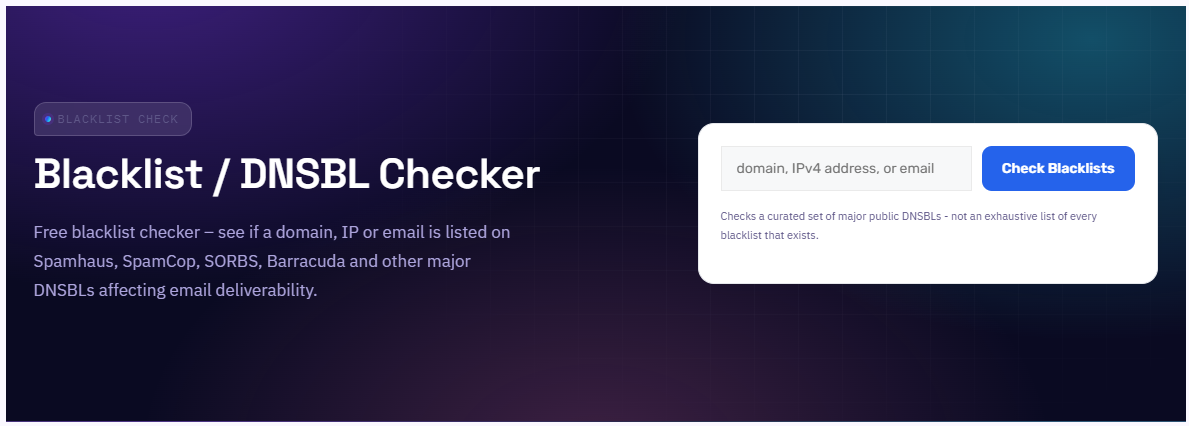
A blacklist checker queries your domain and its sending IP against the major public DNSBLs at once, rather than requiring you to visit each list's own lookup page individually, and reports back exactly which lists - if any - currently have you flagged, along with what each one says the reason was where that information is published.
Check your domain or IP now
Try it freeWhat to Do Once You Confirm a Domain Blacklist Listing
The order of operations matters. Requesting removal before actually fixing whatever caused the listing in the first place almost always fails, and repeated failed requests can make some lists more cautious about approving you the next time.
1. Find the Actual Cause First
Check mail server logs around the time the listing likely started for unusual sending volume, unfamiliar sending IPs, or a spike in bounce messages, which often points at a compromised account. If a specific list publishes a reason for the listing - many do, directly on their lookup results page - start there instead of guessing.
2. Secure Anything That Could Have Been Compromised
Reset passwords on every mailbox with send access, particularly shared or generic accounts like info@ or sales@, and check for unfamiliar forwarding rules or app passwords that could let an attacker keep sending even after the visible password is changed.
3. Clean the List That Triggered It
If a spam trap hit or a high bounce rate is the likely cause, remove addresses that have bounced repeatedly and verify the rest of the list before sending to it again. Sending the same unverified list a second time, immediately after a domain blacklist listing caused by that exact list, is one of the most common ways a removal gets reversed within days.
4. Request Removal Directly From the List
Every major DNSBL - Spamhaus's own Blocklist Removal Center and SpamCop's public lookup and delisting page among them - runs its own free, self-service removal process. You typically enter your domain or IP, review the stated reason for the listing, confirm the underlying issue has been fixed, and submit the request; most lists process these within a few hours to a few days.
One Thing Worth Avoiding Entirely
Paying a third-party 'guaranteed delisting' service rarely speeds anything up, and it is worth being direct about this: there is no charge or fee associated with removal from any of the major, reputable DNSBLs, and a paid middleman has no special access that lets them remove a domain blacklist entry faster than fixing the underlying cause and submitting the same free request yourself. Some of these paid services simply submit the identical self-service form on your behalf for a fee; others are outright scams that take payment and do nothing at all. Treat any offer framed as 'guaranteed' or 'instant' removal from a domain blacklist with real skepticism.
How Long a Domain Blacklist Listing Usually Lasts
This varies enormously by list and by cause. Some dynamic, IP-based lists - built specifically to track live spam runs - are designed to expire automatically within 24 to 48 hours once new reports stop coming in, with no manual action needed at all. Others, particularly reputation-based lists that require a fix-and-request-removal cycle, can persist for days or weeks if the request is submitted before the underlying problem is actually resolved, since a rejected request often has to wait out a cooldown period before it can be resubmitted.
Preventing the Next Domain Blacklist Listing
Recovering from one listing does not make a domain immune to the next one - the underlying conditions that caused it (weak mailbox passwords, an unverified list, shared hosting) usually remain unless specifically addressed.
- Verify email addresses before sending to them, so a stale or purchased list cannot introduce spam trap hits in the first place.
- Use strong, unique passwords and, where available, multi-factor authentication on every mailbox capable of sending, especially shared accounts.
- Watch for sudden volume spikes in your own sending pattern before a receiving server's monitoring system does.
- Consider a dedicated sending IP once volume justifies it, to stop a stranger's bad behavior on shared infrastructure from becoming your problem.
The Real Cost of Leaving a Domain Blacklist Listing Unresolved
A domain blacklist listing that goes unnoticed for weeks is more expensive than the listing itself, because the deliverability damage compounds the longer it runs. Mailbox providers that never explicitly checked the list you were on can still notice the downstream effects - a rising bounce rate, a drop in engagement on mail that never arrived - and independently lower their own trust in your sending domain. Industry groups such as M3AAWG, the Messaging, Malware and Mobile Anti-Abuse Working Group publish sender best-practice guidance precisely because this kind of reputation damage rarely stays contained to a single blacklist - a domain blacklist listing on one list is frequently a leading indicator that a receiving provider's own, separate reputation system is about to start treating your domain more cautiously too, independent of whether that provider checks the original list at all.
This is the main reason a domain blacklist listing deserves same-day attention rather than a "get to it next week" response. The longer a compromised mailbox keeps sending, or the longer an unverified list keeps being mailed to, the more secondary reputation damage accumulates on top of the original listing - damage that does not automatically reverse the moment the listing itself is cleared.
A Quick Domain Blacklist Recovery Checklist
For anyone in the middle of an active domain blacklist listing right now, here is the order that actually works, condensed into one place:
- Confirm the domain blacklist listing with a direct lookup rather than assuming based on symptoms alone.
- Read whatever reason the list itself publishes for the listing before guessing at a cause.
- Fix the underlying issue first - a compromised mailbox, a bad list, a volume spike - before requesting removal.
- Submit removal through that specific list's own free process, never a paid third party.
- Set up ongoing monitoring afterward so the next domain blacklist listing is caught the same day, not weeks later.
Why Ongoing Monitoring Matters More Than a One-Time Check
A domain blacklist listing can happen at any time, not just after an obvious one-off mistake - a compromised mailbox can go unnoticed for weeks, and a shared IP can pick up a bad neighbor's reputation with no warning at all. A single manual check today only tells you about today; it says nothing about a listing that appears next month. Ongoing monitoring re-checks the major lists automatically on a regular schedule and sends an alert the moment your domain is newly listed, so you find out from a notification rather than from a sudden, unexplained drop in delivered mail days or weeks later.
Set up ongoing deliverability monitoring
Try it freeFrequently Asked Questions
Can My Domain Be Blacklisted Even If I Never Sent Spam?
Yes. A compromised mailbox sending spam without your knowledge, a shared IP's reputation dragging your domain along with it, or an old imported list containing a spam trap you never intentionally targeted can all trigger a domain blacklist listing without any deliberate spam on your part.
Will Being on One Blacklist Affect All My Email?
Not necessarily. There are well over a hundred DNSBLs in existence, and receiving mail servers each check a different subset of them - some check only two or three widely trusted lists, others check dozens. Being on a small, obscure list may have almost no visible effect, while being on Spamhaus or another major list checked by most large providers can noticeably affect delivery to a large share of recipients.
How Do I Know Which List Actually Matters?
A checker that queries the major, widely-used DNSBLs at once and reports each result separately is more useful here than checking a single list in isolation, since it shows you exactly which lists have flagged you rather than leaving you to guess whether an obscure listing is actually affecting real delivery.
Does a Domain Blacklist Listing Ever Just Go Away on Its Own?
Sometimes, particularly on dynamic, time-based IP lists that are designed to auto-expire once reports stop. It is not something to rely on for domain-level or reputation-based listings, though, since those typically require an actual removal request once the underlying cause has genuinely been fixed.
Does a Domain Blacklist Listing Affect My Website, Not Just Email?
Almost always no - the DNSBLs discussed here are specifically about email delivery, not web browsing or search rankings, and a domain blacklist listing on a DNSBL has no direct effect on whether visitors can reach your website. It is easy to conflate the two because both use the word "blacklist," but a mail-focused domain blacklist and a browser or search-engine safe-browsing flag are entirely separate systems maintained by entirely separate organizations.
Should I Change My Sending Domain Instead of Fixing the Listing?
Rarely a good first move. A brand-new domain with no sending history is treated cautiously by mailbox providers in its own right, and it does nothing to fix whatever underlying issue caused the original domain blacklist listing - if the cause was a compromised mailbox or an unverified list, switching domains just gives the same problem a fresh reputation to damage.
A domain blacklist listing is rarely permanent and almost never requires paying anyone to fix - what it does require is finding the actual cause, addressing it directly, and requesting removal through the list's own free process rather than guessing or waiting it out.
Check your domain against major blacklists now
Try it free